Words: Rafal Kujawski
From 1 December 2026, Australia’s Workplace Exposure Standards become Workplace Exposure Limits, and although most people in cleaning will read that as a rename on a list, many childcare and aged care operators expect a new chlorine number to arrive. No such number is coming. The chemical that does change for this industry has received little attention.
This first full review since 2003 lowers limits for 177 substances, sets a limit for 31 substances for the first time and lists 33 non-threshold genotoxic carcinogens with no numerical limit, because Safe Work Australia says no practical protective exposure level exists for them.
Cleaning contractors should watch hydrogen peroxide, which halves from 1 ppm to 0.5 ppm as an eight-hour average in the breathing zone, so anyone using peroxide chemistry should examine how crews apply it. Sulphur dioxide loses its 2 ppm eight-hour average and takes a 0.25 ppm short-term limit, down from 5 ppm, peracetic acid enters the list with a peak limit of 0.4 ppm, and diesel particulate receives a national limit of 0.01 mg/m³ as respirable elemental carbon, one tenth of the 0.1 mg/m³ submicron elemental carbon standard in several state mining regulations.
In June 2026 Safe Work Australia published its decision on nine chemicals including chlorine, and because WHS ministers reached no majority for the proposed new limits, chlorine keeps its peak limitation of 1 ppm, a ceiling, not an average. The tighter package floated in the consultation does not apply in December.
That matters for a care facility, because December will not turn an aged care quality visit into a chlorine inspection. The listing covers elemental chlorine in the air, not every product that carries a chlorine species on the SDS. Off-gassing from mixed chlorine products or from areas with poor ventilation remains a problem under your existing SDS obligations, as it did last year.
Wet time decides the claim
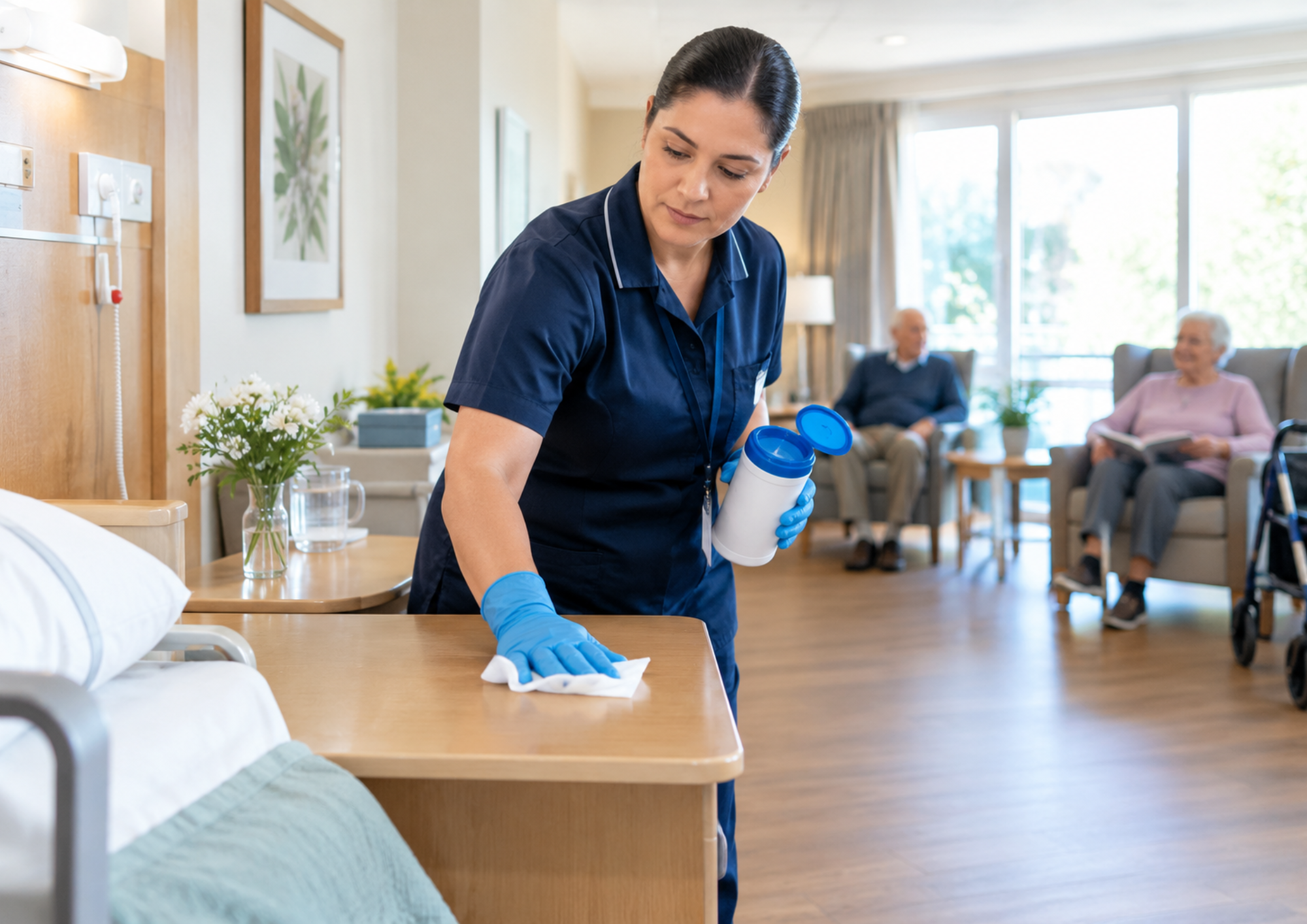
The more useful December question concerns wet contact time, because most disinfectant wipes need it to deliver the label claim and, after close to thirty years around cleaning rosters, I can say that time goes missing from daily practice. A carer before breakfast wipes a bedside table, call button, rail, door handle and toilet seat, and each surface dries before she leaves the room. The roster gives her no spare minutes, and nobody coaches a carer to stand still between rooms while the next resident rings.
In childcare, the NHMRC Staying Healthy guidelines direct detergent and warm water after every nappy change, a clean water rinse and drying, with disinfection after body fluids, so a leave-on wipe cannot replace that routine. Quaternary ammonium residue can build on change tables, high chairs and rails that small hands touch every day. The Aged Care IPC Guide accepts a two-in-one detergent-disinfectant for routine work but expects the manufacturer’s wet time and a dry surface, and it requires ARTG-listed hospital-grade products in residential and centre-based care.
Before 1 December, match every chemical you use or generate against Safe Work Australia’s comparison table, then pull the SDS, label and instructions for every disinfectant you stock and write down the labelled wet time. Watch one crew work through a full roster, and if surfaces dry before that time expires, the process does not match the label, whatever the training records say. The question worth asking remains the same: does this product work the way your staff work, and can you show it?
Rafal Kujawski, Managing Director, Sanifect ICM. Sanifect ICM supplies infection-control products and advisory services to care and industry sites. This is a signed opinion.