Words: Charlotte Huston
Hazardous material removal has never been a risk-free endeavour. Especially when compounded with restoration, the stakes rise quickly. What was once perhaps framed as a ‘clean-up job’ now demands controlled remediation. It is complex and technical work where missteps carry real consequences, and these expectations are now being rigorously enforced.
Published in March 2026, the Safe Work Australia Model Code of Practice: ‘Managing the risks of biological hazards at work’ formally recognises restoration and remediation workers as a higher-risk occupation and directs employers to engage technical specialists for complex contamination. In New South Wales, this will become mandatory from July 2026, with other jurisdictions expected to follow. Under growing scrutiny from regulators, insurers and industry personnel, the sector is entering a new phase defined by proactive risk management.
Recognition not reinvention
“Restoration is, at its core, the removal of hazards and hazardous materials, particularly biological hazards,” Managing Director of Cleaning Inspection Restoration and Testing Services (CIRTS) Sam Ruff says. Ruff also chairs the RIA (Restoration Industry Association) Australasia Advocacy and Membership Committee and has been closely involved in the response to the Safe Work Australia Model Code of Practice on managing biological hazards, as well as the development of the Restoration Industry Code of Practice.
As stated in an RIA bulletin about the code adoption, “These recognitions are not incidental. They reflect the technical complexity and specialist nature of restoration and remediation work, as well as the industry’s critical role in returning hazardous environments to safe and habitable conditions, a unique function that sits at the intersection of workplace health and safety, public health and building science.”
What has changed is not the work itself, but who the market expects and qualifies to carry it out and the standard to which it is delivered.
“Instead, the real growth area is recognition,” Ruff explains. “There is a clear and overdue shift toward acknowledging that property damage involving biological, chemical and fire-affected materials must be handled by competent and qualified restoration specialists – not generalist trades, builders or labourers.”
Alongside the Safe Work Code of Practice, AS-IICRC S500:2025 and AS-IICRC S520:2025 address standards for water damage and mould remediation, while the RIA Codes of Practice formalise industry commitments to training, certification and quality outcomes. Together these frameworks signal clear market demands and requirements that hazardous material work – whether formally regulated or not – should be carried out by those qualified to do it properly.
There are cultural shifts, too, as informed clients raise the bar on service and outcome. “Clients are far less accepting of superficial fixes like painting over affected areas,” Managing Director of Cleopatra Restoration Group, Jesse Mullen, says. “Access to information has people acutely more aware of what proper remediation involves and looks like.”
This growing awareness is pushing contractors toward more transparent and operational approaches in which outcomes are not only delivered, but also clearly evidenced.
From clean-up to controlled remediation
While no specialist should approach hazardous materials reactively, the risk remains when processes and oversight fall short. That gap is being addressed through proven methods.
“The industry standards that govern restoration work have never endorsed a reactive ‘clean it and close it’ approach,” says Ruff, as standards covering water damage, mould, fire and smoke have long necessitated a staged and systematic process.
“Categorisation of losses, drying and psychrometric monitoring, containment, engineering controls, post-remediation verification and documented outcomes are all part of a controlled approach,” he adds. “This has been embedded in professional standards for decades.”
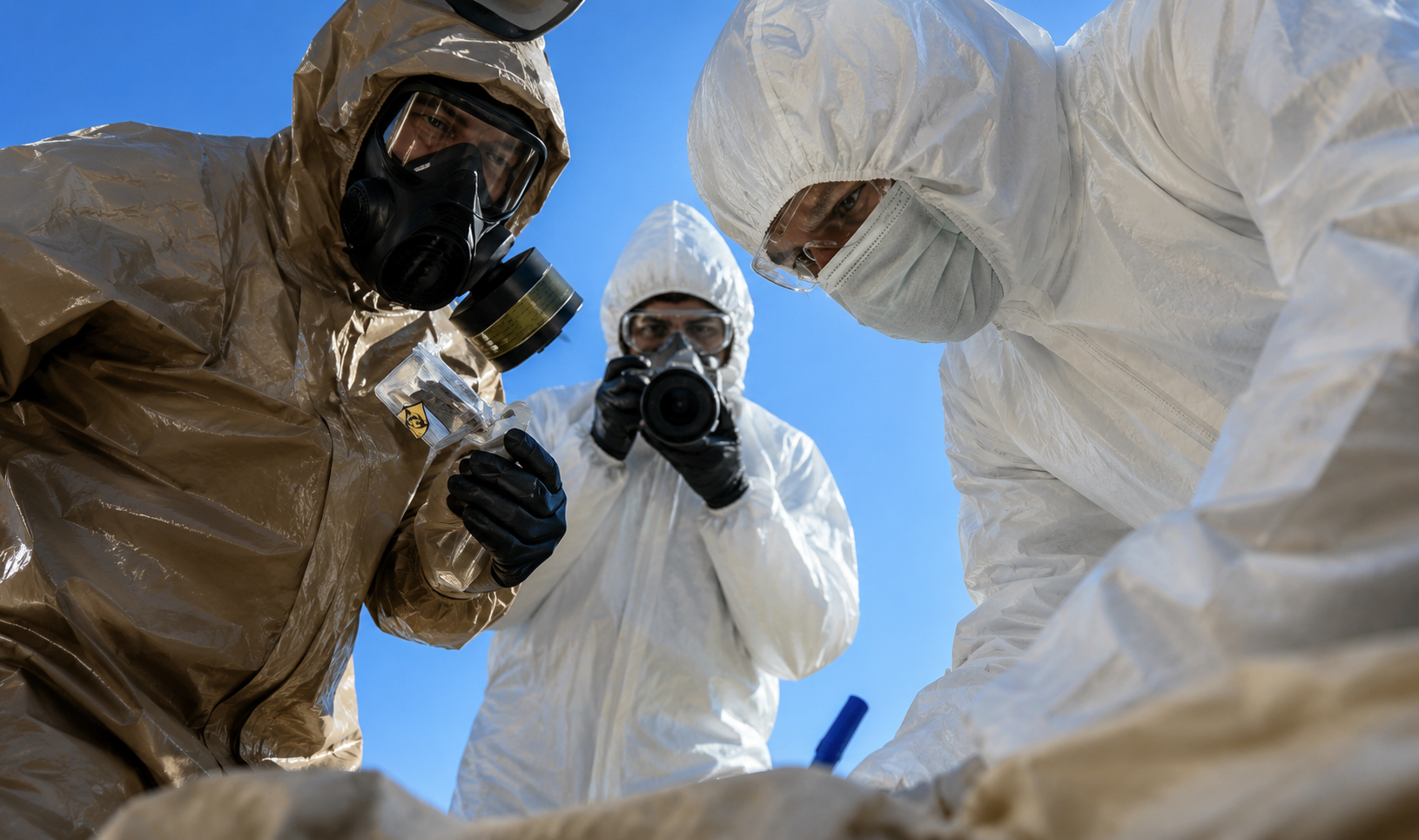
For Mullen, however, controlled remediation reflects the broader shift driven by standards such as the IICRC S520, which sets out procedures and precautions for mould remediation. These guidelines have helped formalise best practice. Effective mould remediation can be achieved, first, by containment to isolate affected areas and prevent cross-contamination. This is supported by controlled demolition, appropriate PPE and technicians trained in hazardous material handling.
“The goal is to remove mould from both surfaces and the air, returning the environment to a safe Condition 1 (normal fungal ecology) standard,” Mullen adds. In Ruff’s work, managing hazardous materials safely follows four core steps: hazard identification, risk assessment, application of controls and review.
“Before and on attendance, we identify physical, chemical, biological and psychosocial risks. In restoration, this includes contamination, mould, asbestos and lead, fire-related residues, illicit substances, bloodborne pathogens, structural and electrical hazards and environmental conditions such as heat, humidity and confined spaces. Testing and sampling are often used to inform this stage.”
Professionals then assess the likelihood and consequences for each hazard, maintaining worker consultation and clear communication. For complex scenarios, independent environmental professionals may be engaged. Control begins with elimination, such as addressing water ingress or removing non-restorable materials. This is followed by containment and engineering controls, including HEPA (High-Efficiency Particulate Air) filtration, negative pressure and decontamination zones. Administrative measures include Safe Work Method Statements, training and fatigue management, with PPE as the final layer.
“Ongoing monitoring, documentation and feedback inform continual improvement of procedures,” adds Ruff. This reflects a rigorous approach to risk management, protecting both the site and the team while ensuring an effective resolution.
Best practice equals best insurance
What has shifted in the hazardous materials and restoration industry is the level of auditing applied to completed work, particularly within the insurance sector. What now needs to change is how the industry is engaged.
As client understanding has improved significantly, so has it among insurers. “However, the understanding of how and when we are engaged, and how that affects our ability to deliver compliant, standards-based outcomes, is still lagging,” says Ruff. “In the past, restoration was often treated as a quick clean-up. Speed and cost dominated scope discussions, and standards-aligned approaches were less common. The result was under-remediation and rework, not because standards allowed it, but because the commercial framework did not fully support them.”
The introduction of formal standards and increased regulatory oversight now means insurers and third-party advocates are raising expectations and requiring clear evidence that works meet accepted standards.
“Without proper documentation and controls such as containment, contractors risk disputes, liability and difficulty proving the quality of their work,” says Mullen. “Staying out of trouble is critical,” he adds. “Builders, insurers and policyholders all want to avoid prolonged disputes. As restoration is often one of the first steps, it provides an opportunity to set the claim on the right path from the outset through competent, well-documented, safe work.”
Additional pressure on industry capacity is also driven by Australia’s environmental catastrophe profile, with the skills gap most exposed during major events. Flood, fire, cyclone and storm events are becoming more frequent and severe, and increasingly overlap, with new events arriving before the previous one is fully restored.
“Warmer and wetter conditions across much of the country create the environments in which mould and biological contamination establish more quickly and persist longer, which directly increases the biological hazard profile of the work and the urgency of a competent, science-based response,” says Ruff.
The industry is now shaped not only by insurance pressures, but also by the growing impact of environmental conditions. Mother Nature will always have her say in the matter.
Technology as evidence
So, what is one of the most effective ways to document risk and prove outcomes? According to Ruff and Mullen, technology sits at the centre of both defensible restoration and verifiable evidence.
At the assessment stage, tools such as moisture meters, hygrometers and thermal imaging identify hidden dampness beyond visible surfaces, while borescopes allow inspection of concealed spaces. Surface and air sampling, including spore traps, ATP (Adenosine Triphosphate) and laboratory-based chemical testing, provide quantified baseline data.
During remediation, containment is verified using pressure monitors, while HEPA filtration and negative air machines create controlled environments. Equipment use is logged for traceability. Continuous psychrometric monitoring tracks temperature and humidity to optimise drying, supported by energy-efficient dehumidifiers and high-velocity air movers.
Worker protection has also advanced, with modern powered air-purifying respirators offering more practical and reliable respiratory protection in contaminated environments. Documentation has evolved through digital platforms such as Matterport, which capture site conditions in detail, while mobile testing kits provide rapid on-site results. AI-assisted systems are also emerging, helping reduce administrative workload without compromising quality.
For Mullen, who specialises in structural drying and mould remediation, tools such as Tramex moisture meters with Bluetooth integration enable data to be captured directly into reports and floor plans. “Platforms like Magicplan allow us to complete reports on-site, ensuring accuracy and immediate delivery to clients. This improves efficiency while strengthening documentation and compliance.”
Ruff, also Managing Director of Restoration Innovations, points to advances in chemical formulation. The company imports Serum products into Australia, including hydrogen peroxide-based mould remediation solutions.
Used in Mullen’s projects, Serum 1000 “draws mould and contaminants to the surface, allowing them to be removed using HEPA vacuuming rather than aggressive sanding”.
“This reduces labour time, improves technician safety and enables large-scale remediation to be completed faster and more cost-effectively,” says Mullen.
Not just a service but a profession
To stay competitive and compliant, restoration businesses should focus on doing a few things well: invest in certification and align with industry standards, engage with peak bodies to stay ahead of regulation rather than reacting to it, commit to evidence-based delivery and thorough documentation, and develop your people with clear intent.
As Ruff succinctly puts it, “Above all, position restoration as the professional, science-based service it is. That is what the regulatory environment now requires, and what the commercial environment will increasingly reward.”
This article first appeared in the winter 2026 print edition of INCLEAN Magazine