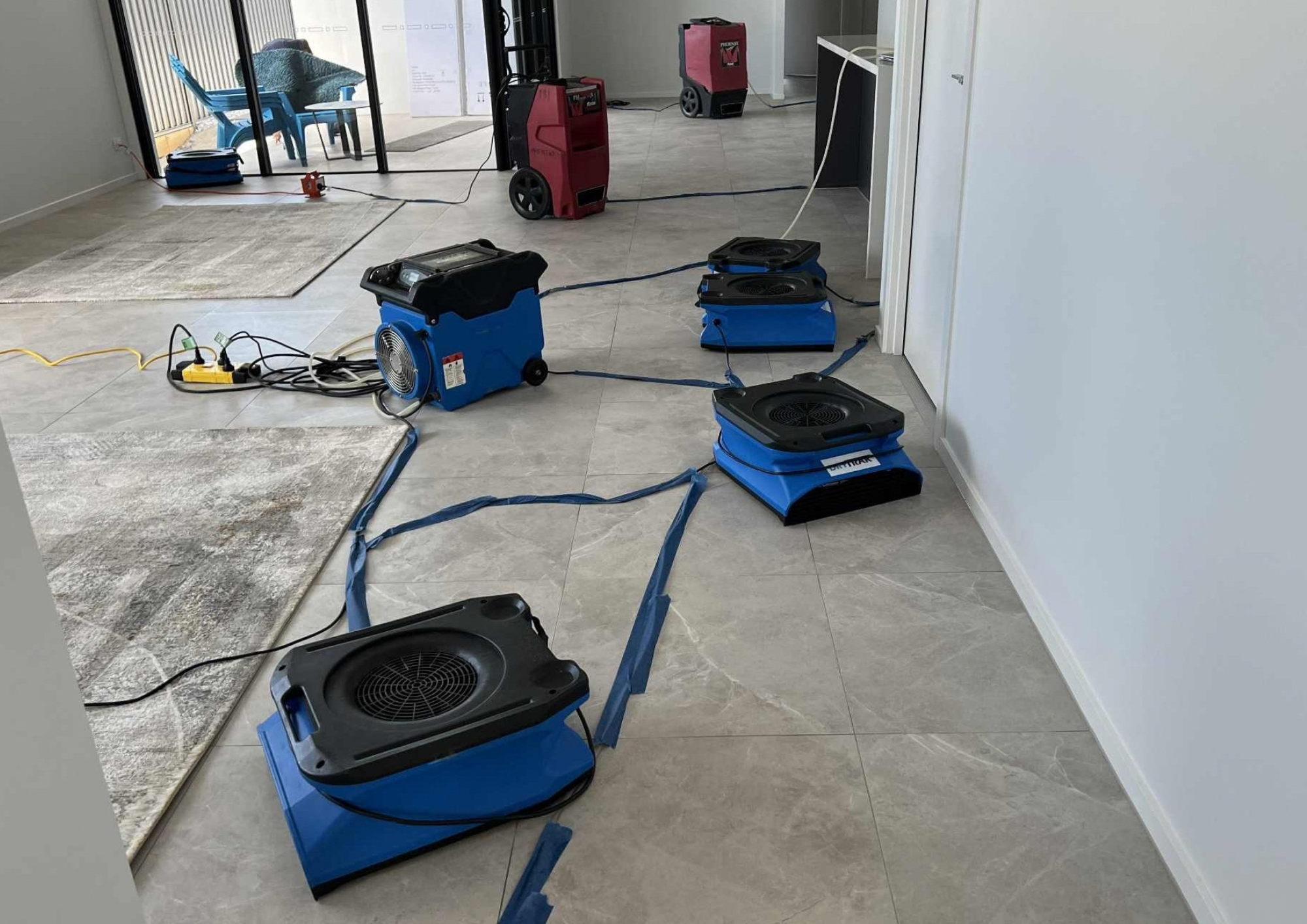
Restoration technicians who document dehumidifier performance on water damage jobs need evidence that stands up to scrutiny from insurers, clients and colleagues, yet the most common field method leaves room for sizable error.
In a recent article for ISSA’s Cleanfax, ANSI/IICRC Standards Committee chair and vice chair of the ANSI/IICRC S500 Standard for Professional Water Damage Restoration, Brandon Burton, describes an alternative that uses enthalpy to show how much water a machine removes.
For years the industry has judged dehumidifiers by grain depression, which compares the moisture in the air entering a machine with the moisture in the air leaving it, measured in grains per pound (GPP). One pound (454 grams) equals 7000 grains, so GPP describes the weight of water that a pound of dry air carries. The method gives a fast confirmation that a machine removes water, but it depends on two sets of temperature and relative humidity readings. Relative humidity expresses how full the air is compared with how much moisture it can hold at that temperature, and because warm air holds more moisture, a small error at the hot outlet grows into a large error once converted to GPP.
To illustrate the problem, Burton points to a dehumidifier with an outlet condition of 38 degrees Celsius and 20 percent relative humidity, where a hygrometer accurate to within three percent could read anywhere between 17 and 23 percent. That range translates to a spread of 49 to 66 GPP, and a gap that wide makes any grain depression calculation unreliable.
How enthalpy improves the reading
Enthalpy measures the total heat content of air, which includes the sensible heat a technician can feel and the latent heat locked in water vapour. When a dehumidifier condenses vapour into liquid, the latent heat converts to sensible heat, and that conversion explains why the air leaving a machine runs hotter than the air entering. A significant temperature rise across the unit signals real water removal, and technicians can use that rise to calculate how much.
The method needs five readings that field meters capture with confidence: inlet temperature, inlet relative humidity, outlet temperature, amp draw and the airflow of the unit in cubic feet per minute, which manufacturers publish in manuals and specification sheets. Temperature meters deliver high accuracy, and relative humidity at the cooler inlet carries a smaller error than at the hot outlet. Amp draw matters because part of the temperature rise comes from the electrical power the machine consumes, while condensing water produces the balance.
Technicians begin by estimating the heat from operation, which depends on amp draw, voltage and airflow, and for most dehumidifiers this adds between four and six degrees Celsius to the air temperature. Technicians who want to keep the maths simple can use that range. The inlet reading goes on a psychrometric chart to find inlet GPP, which reaches about 92 for air at 27 degrees Celsius and 60 percent relative humidity. Adding the operational heat rise and following the enthalpy line, the diagonal running across the chart, down to the outlet temperature gives a point that reads across to an outlet figure of about 74 GPP.
A psychrometric chart maps the relationship between temperature, relative humidity, GPP, vapour pressure and heat content. Technicians do not need to memorise every line to benefit from it, because the chart shows the predictable path of air through a machine: air enters, moisture condenses on the coil and the air leaves drier and warmer.
Burton argues that grain depression falters because most handheld meters struggle to read relative humidity at high temperatures with precision. Technicians who practise the enthalpy method will produce more reliable field documentation and build a deeper understanding of the conditions they control to support drying.
A longer version of this article first appeared in Cleanfax, written by Brandon Burton.